Course Overview
This two-day immersive course provides comprehensive training in ultrasound-guided regional anesthesia, enabling clinicians to perform a range of nerve blocks safely and effectively. With a balanced focus on theoretical instruction and extensive hands-on practice, participants will develop the skills required to optimize imaging, identify key anatomical landmarks, and safely guide needle placement for various regional blocks. This course emphasizes safety, precision, and the reduction of complications during anesthetic procedures.
Objectives
On completion of this two-day clinically focused ultrasound program, learners will:
- Describe a plan for troubleshooting image optimisation using the various probe moves and ultrasound machine setting adjustments
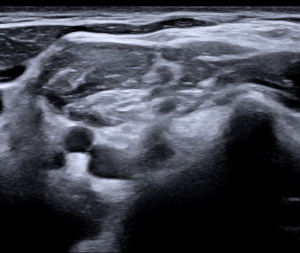
- Use a structured sonographic technique to identify key anatomical landmarks for the performance of the following regional blocks:
- knee - genicular, adductor and I-PACK, sciatic
- hip - femoral, fascia iliaca - suprainguinal and infrainguinal approach, PENG
- shoulder - brachial plexus - interscalene and supraclavicular approach
- trunk - serratus anterior, erector spinae plane block and transversus abdominal plane block
- Describe optimum patient positioning and needle approach for each of the regional blocks for knee, hip, shoulder and truncal surgeries
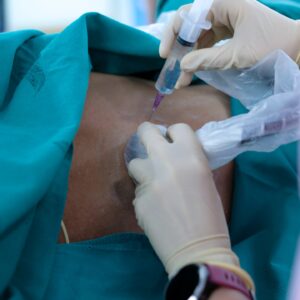
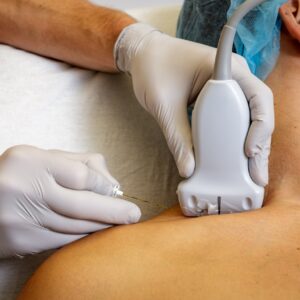
- Demonstrate ultrasound guided needle placement in-plane and out-of-plane on ultrasound phantoms
- Discuss how to avoid common complications of ultrasound guided regional blocks
Features
-
Modules (total)
7
-
Skill level
All
-
Duration (days)
2
-
Lectures (hours)
3.75
-
Scan time (hours)
9.0
-
Clinician
Virtual
Class times
Day 1: 0830 – 1700
Day 2: 0900 – 1700
Modules
Image optimisation – interactive practical session
- Explore system controls
- Understand the impact of optimisation on the image
- Presets, frequency, depth, focus and gain
- How to label the image
- How to store and review images
Probe Manipulation
- Probe care
- Probe moves
- Probe grip
- Probe and screen orientation
- 3D awareness of the anatomical position of the organs
Procedural Guidance
- Principles of needle guidance
- Terminology – In-plane, out-of-plane, LAX and SAX
- Techniques to improve imaging
- limitations and pitfalls
- sonographic anatomy of common injection sites
- patient positioning
- needle approach
- equipment preparation
- ergonomics of safe procedures
- Clinical utility and applications
Scanning, scanning and more scanning of real people
Identify the anatomy and needle approach on real people
Stick needles into a wide variety ultrasound phantoms for procedural practice (we want our patients to come back 🙂 )
Blocks for knee surgery
- scan technique for femoral, adductor canal, genicular, iPACK blocks
- sonoanatomy
- recognise anisotropy
- limitations and pitfalls
- clinical utility and application
Scanning, scanning and more scanning of real people
Blocks for hip surgery
- scan technique for suprainguinal fascia iliaca, PENG blocks
- sonoanatomy
- recognise anisotropy
- limitations and pitfalls
- clinical utility and application
Scanning, scanning and more scanning of real people
Blocks for shoulder surgery
- scan technique for brachial plexus blocks – interscalene, supraclavicular, infraclavicular and axillary nerves
- sonoanatomy
- recognise anisotropy
- limitations and pitfalls
- clinical utility and application
Scanning, scanning and more scanning of real people
Blocks for truncal surgery
- scan technique for TAP, erector spinae, serratus, PECS 1 + 2 blocks
- sonoanatomy
- recognise anisotropy
- limitations and pitfalls
- clinical utility and application
Scanning, scanning and more scanning of real people
CME details
ACEM | Approved for 16.5 ACEM CPD hours
ACRRM |This CPD activity has been approved for the following hours and types: Educational activities hours: 11.5 | Reviewing performance hours: 8.75 | This activity is eligible for RPGP – Anaesthetics | MOPS hours: 1 MOPS (Radiology) hour | Curriculum domains: Respond to medical emergencies | Curriculum learning areas: ANA, MSK, IMAG, PROC.
ANZCA | Participants in the ANZCA CPD program can claim attendance under the Knowledge and Skills category ‘Short format learning’
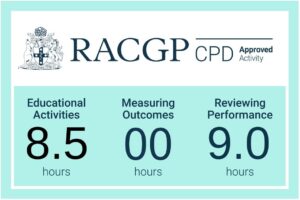
RACGP | CPD Accredited Activity 1452274 | This activity has been approved for the following hours and types: Educational activities hours: 10.5 | Reviewing performance hours: 9.0 | This activity has been approved for Anaesthetic rural procedural training grant; Emergency Medicine rural procedural training grant; Obstetric rural procedural training grant; Surgery rural procedural training grant
Approved by RACGP for the Rural Procedural Grants Program – GPs can receive $2000 per day for a maximum of 10 days of training per financial year, GPs providing hospital based emergency services can receive up to three days of eligible training per financial year.
A great training course is only the beginning of your ultrasound learning journey
To help you master ultrasound and lasting change from training we engage you from the outset
Before your course:
There are pre course activities & access to preparatory learning resources to maximise your in-class experience
During your course:
- Short, sharp information sessions to provide foundational knowledge and clinical context
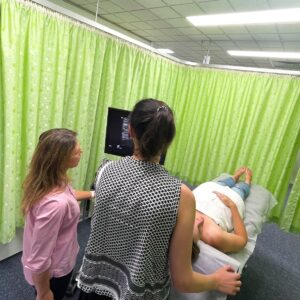
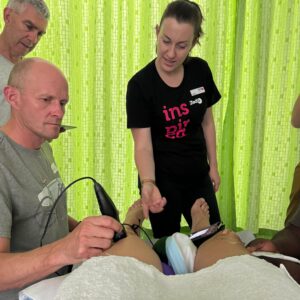
- Lots of hands-on practical sessions with real people to scan (including for TV and obstetric scans). Our standardised patients models vary in age, size, shape and mobility to make the transition to clinical reality easier.
- Case studies led by practising clinicians to demonstrate clinical utility
- A variety of different machines to learn on
- At the conclusion of your course we’ll lead you to create a skills development action plan, creating a pathway that you can use to apply your newly acquired skills, promote clinical integration and ultimately reach your final objective – ultrasound competency
After your course:
The learning continues
- We encourage self-directed learning in the workplace with structured active learning plans
- A great selection of free access online medical ultrasound (FoamUS) learning resources
- You can subscribe to the weekly wrap – a weekly curation of ultrasound related hot tips and journal articles
More Ways Zedu Can support your ultrasound skills development:
- Image review – details here
- Follow-up coaching with our Zedu coaches
|
16.5 CPD hours
|

CPD Accredited Activity
|

CPD Short Format Learning
|
CPD Approved Activity
|
Lorem ipsum dolor sit amet, consectetur adipiscing elit, sed do eiusmod tempor incididunt ut labore et dolore magna aliqua. Ut enim ad minim veniam, quis nostrud exercitation ullamco laboris nisi ut aliquip ex ea commodo consequat. Duis aute irure dolor in reprehenderit in voluptate velit esse cillum dolore eu fugiat nulla pariatur. Excepteur sint occaecat cupidatat non proident, sunt in culpa qui officia deserunt mollit anim id est laborum.
Lorem ipsum dolor sit amet, consectetur adipiscing elit, sed do eiusmod tempor incididunt ut labore et dolore magna aliqua. Ut enim ad minim veniam, quis nostrud exercitation ullamco laboris nisi ut aliquip ex ea commodo consequat. Duis aute irure dolor in reprehenderit in voluptate velit esse cillum dolore eu fugiat nulla pariatur. Excepteur sint occaecat cupidatat non proident, sunt in culpa qui officia deserunt mollit anim id est laborum.
This course caters to all skill levels, from beginners seeking to establish a solid foundation to experienced clinicians aiming to refine advanced techniques. If you’re committed to improving patient safety, minimising complications, and achieving superior outcomes in regional anaesthesia, this course is for you.
- Anaesthetists: Seeking to improve their proficiency in performing regional blocks using ultrasound.
- Pain Specialists: Wishing to expand their toolkit for managing chronic and acute pain with regional techniques.
- Emergency Physicians: Interested in incorporating ultrasound-guided nerve blocks into acute pain management protocols.
- Critical Care Physicians: Looking to safely perform regional blocks in intensive care settings.
- Orthopedic Surgeons: Wanting to improve perioperative pain management strategies for joint and limb surgeries.
- General Practitioners and Proceduralists: Performing anesthetic procedures for minor surgeries or pain relief.
- Trainees and Fellows in Anaesthesia or Pain Medicine: Building foundational skills and confidence in ultrasound-guided techniques
Key benefits for attendees
- Enhanced Confidence in Regional Anaesthesia
Gain hands-on experience performing ultrasound-guided nerve blocks for upper and lower limb surgeries, as well as truncal procedures.
- Comprehensive Practical Training
Benefit from 9 hours of hands-on scanning with real patients and phantoms, focusing on needle guidance and anatomy identification in a safe, controlled environment.
- Real-World Clinical Relevance
Learn techniques tailored for practical application, addressing real-world challenges in patient positioning, sonoanatomy, and needle placement.
- Expert Instruction
Receive guidance from experienced instructors who provide detailed feedback and troubleshooting strategies.
- Immediate Skill Application
Develop practical skills that can be directly applied in clinical contexts to improve patient outcomes and reduce complications.
- Structured Learning Approach
Follow a systematic, step-by-step methodology for image optimization, probe manipulation, and procedural execution.
- Focus on Safety and Efficiency
Understand how to avoid common pitfalls and complications in ultrasound-guided regional anaesthesia
Course Inclusions
Lorem ipsum dolor sit amet, consectetur adipiscing elit, sed do eiusmod tempor incididunt ut labore et dolore magna aliqua. Ut enim ad minim veniam, quis nostrud exercitation ullamco laboris nisi ut aliquip ex ea commodo consequat. Duis aute irure dolor in reprehenderit in voluptate velit esse cillum dolore eu fugiat nulla pariatur. Excepteur sint occaecat cupidatat non proident, sunt in culpa qui officia deserunt mollit anim id est laborum.
Lorem ipsum dolor sit amet, consectetur adipiscing elit, sed do eiusmod tempor incididunt ut labore et dolore magna aliqua. Ut enim ad minim veniam, quis nostrud exercitation ullamco laboris nisi ut aliquip ex ea commodo consequat. Duis aute irure dolor in reprehenderit in voluptate velit esse cillum dolore eu fugiat nulla pariatur. Excepteur sint occaecat cupidatat non proident, sunt in culpa qui officia deserunt mollit anim id est laborum.